DIA
Design work for DIA, collected from the studios behind it.
- Design cases
- 4
- Studio
- 1
- Latest work added
- Oct 2026
- Creative Coding 4
Design cases by studio
Daniel Wenzel (4)
- Mapping — DIA Tools
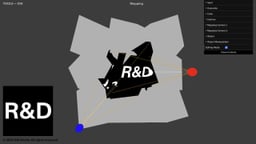
- Mapping is a browser-based projection experiment in the DIA Tools collection, hosted on Daniel Wenzel’s website. It places editable typography onto arrays of three-dimensional objects using two adjustable mapping cameras. The scene shows the relationship between the text input, projection viewpoints and receiving geometry, with a separate preview of the source lettering. Users can select cubes, spheres, cylinders or toruses, change repetition and spacing, and control object rotation, scale and movement. Camera distance, angle and field of view provide further ways to alter the projection. The default R&D input uses Rand Medium. An editing mode keeps the construction of the scene visible, making the tool useful for exploring how viewpoint changes the reading of type.
- Ouroborus — DIA Tools
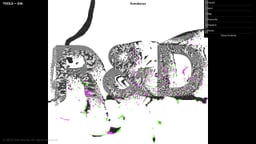
- Ouroborus is a live typographic image-processing tool in the DIA Tools collection, hosted on Daniel Wenzel’s website. Editable text becomes the input for animated distortion, noise and colour effects. Its preset menu includes Wood Grain, Chroma, Ink Bleed, Op Art, Old TV and Fragments, offering distinct starting points for exploration. Further controls cover noise type, scale and speed, displacement, zoom, expansion, aberration and flicker. The default R&D lettering uses Rand Medium. Wood Grain breaks the letterforms into textured patterns, while Chroma produces softened colour separation. The tool exposes how different settings transform the same source typography through a live preview.
- Scan — DIA Tools
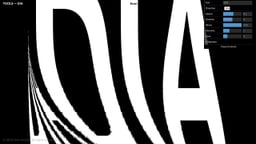
- Scan is a browser-based kinetic typography tool in the DIA Tools collection, hosted on Daniel Wenzel’s website. It divides large letterforms into animated slices, producing a shifting black-and-white image from editable text. Controls expose horizontal or vertical direction, speed, rotation, slice count, intensity and easing. A repeater section extends the experiment into a grid with separate horizontal and vertical repetition and options for random direction and timing. The interface places the output beside a compact control panel, so changes can be assessed directly as the typography moves. The live sketch uses Rand Medium and presents the tool as an interactive experiment.
- Tangle — DIA Tools
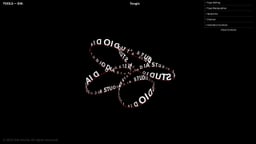
- Tangle is an interactive typography experiment in the DIA Tools collection, hosted on Daniel Wenzel’s website. Repeated words travel around a twisting three-dimensional curve, combining letter scale and movement with a configurable geometric path. The interface separates typesetting, type manipulation, geometry, camera and animation controls. Users can change the text, font size and repetition count, then adjust the length, rotation and frequency of three arms that define the structure. Camera controls change the view, while ticker and rotation speeds govern motion. Reset and randomise functions offer ways to compare configurations. The default DIA STUDIO text uses Rand Medium, appearing as a continuous ribbon of letters against a black field.