A festival lineup is a promise of good company. Who will make you rethink the way you work? Who might be better on stage than you expected? And whose name should you look up before everyone starts talking about them?
OFFF Barcelona’s first 20 names for 2027 give us plenty to work with. The festival returns to Disseny Hub Barcelona on May 6–8, bringing together branding studios, animators, type designers and people who make images sound as good as they look.
Here’s our way into the announcement: a little background on the people coming, why they feel relevant now, and what makes them an interesting part of these three days.
Porto Rocha: our favourite studio of the past few years
Porto Rocha has been our favourite studio of the past few years.
For us, Porto Rocha brings the freshest perspective in branding, backed by impeccable craft.
The agency works across New York and London, moving between cultural institutions and businesses with enormous audiences. Hearing how Leo Porto and Felipe Rocha sustain that combination of fresh thinking and technical precision is one of our biggest reasons to go to OFFF.
There’s plenty of recent momentum behind the invitation. Its 2026 work for Tinder has put the team in front of another very large audience, while its public calendar lists appearances from Serifalaris to Web Summit Rio this year. Those events feature different members of the team; Leo Porto and Felipe Rocha are both named for OFFF 2027.
Hearing the founding pair together is the attraction here. The work gives them a lot to draw on, but the more interesting festival conversation is about how they make decisions, build a team and keep their judgement sharp as the agency grows.


Koto: a view from inside a global studio
Koto offers a different picture of studio life. It describes itself as five studios across three continents, with a practice spanning strategy, identity and digital experiences. Its presence gives OFFF a chance to look inside the collaboration and creative leadership behind work seen by millions of people.
Instagram’s 2026 wordmark and the recent Amazon system are useful context for the scale of its practice. What makes Koto worth hearing is the experience behind those credits: coordinating teams, working closely with a client’s own designers and getting an ambitious idea through a very large organisation.
The studio has also been part of the festival circuit: Fred North spoke at Forward Berlin in 2025. The individual representing Koto at OFFF wasn’t named in the material we reviewed. That detail will matter as the programme develops; a studio’s name can cover quite a few different perspectives.

CATK: a good reason to listen as closely as you look
Berlin’s Colors And The Kids, usually shortened to CATK, brings one of the most appealing combinations in the first announcement. Image, motion and sound are conceived as a single discipline. The same team carries an idea through strategy, design and production.
Founded in 2008 and still led by its partners, CATK has had time to develop that way of working. Its 2026 identity for Luminary is a recent sign of the studio’s interest in technology and experimentation; music and sonic identity are equally central to its practice.
For OFFF, that suggests a broader conversation about creative process: how do you build a shared language between disciplines, and what changes when sound is involved from the beginning? CATK’s calendar lists five speaking engagements across 2025–2026, including Us By Night and Forward. It’s an active voice in this conversation, with a perspective that should travel well to a festival screen and sound system.


40MUSTAQEL and Pupila: two perspectives worth travelling for
40MUSTAQEL brings Cairo’s independent design culture into the mix. Arabic typography, publishing and cultural identity are central to the studio’s appeal. It’s a particularly interesting presence in a programme where many of the familiar reference points come from European and American branding.
There’s a recent speaking trail to follow, too. In May 2026, founder Nada Hesham appeared at All Flows for a session on individual and collective identities in brand design. The studio also took part in the University of New Mexico’s editorial design lecture series in February. That gives its OFFF appearance a useful context: a practice already sharing ideas about design, language and belonging across different audiences.
Costa Rica’s Pupila adds another reason to look beyond the usual studio map. Alongside its branding practice, it has been involved in building a design community through events such as FID. There’s a valuable festival perspective in being both a maker and someone who brings other makers together.
Alfredo Enciso represented Pupila at The Design Conference Australia in July 2026, with a talk and a workshop. For Barcelona, the interest is in the studio’s experience of developing a practice from Costa Rica and taking it into international conversations. Its work has a strong sense of place; hearing how that relationship is sustained could be one of the rewards of this lineup.
Adriana Mora: an individual voice in a collaborative world
Adriana Mora works across 3D, art direction, illustration and image-making. Her presence brings a more personal scale to a lineup full of studio names: the choices, collaborations and visual instincts of one practitioner.
There’s a nice connection within the announcement. Mora shares a 3D design credit on Porto Rocha’s 2026 Tinder identity with Pedro Veneziano. Her collaboration with Cèlia Pladevall, Commercial Confectionery, was also featured in June 2026. Together, those credits show a practice moving between a large branding team and a self-directed photographic publication.
That makes her an interesting person to hear at OFFF: someone who can speak from inside collaborations while maintaining a distinct visual curiosity of her own.


Panic and Art&Graft: the people behind the moving image
Panic brings illustration, animation and a playful visual temperament to the programme. The appeal is the studio’s ability to work across different styles while keeping the result expressive and full of character. Its recent work reaches from sports advertising to documentary storytelling, giving it a broad view of what animation can do.
For a festival audience, the useful story is how that variety happens inside a studio: who gets brought into a project, how a team settles on a visual direction, and how it stays inventive under commercial constraints. The work for Nike and Inside Samsung provides recent context without needing to become the whole conversation.
Art&Graft brings a longer studio history to the same discussion. The team celebrated 15 years in 2025, a year that also included appearances at London Motion, Motion Folks and MO:DE. Its own account of the year describes internal experiments, time set aside for developing skills and ongoing work with Google DeepMind.
That makes it relevant to one of the questions hanging over creative festivals: how does an established studio keep learning as its tools change? Its 2026 animation for What Is Dyslexia? is another reminder of the human storytelling in its practice. At OFFF, the combination of experience, experimentation and character work is the reason to pay attention.


Three distinctive voices for the stage
Zipeng Zhu brings humour, colour and a very personal point of view. The designer behind DAZZLE treats visual communication as a chance to entertain, and his public appearances connect that energy with his experience as a Chinese immigrant and queer creative. His 2025 Graphika Manila talk, Over the Rainbow, and Adobe’s February 2026 feature are good introductions. He feels especially suited to a festival where personality is part of the draw.
Aaron Draplin is the experienced storyteller in this group. LetterWest’s 2026 organisers put his career total at more than 575 speaking engagements. His appeal comes from the closeness of design, collecting and making things of his own. For an audience balancing client work with personal ambition, that’s a perspective with plenty of life in it.
Dalton Maag is a must-see for us. These are heavyweights of custom type.
Right now, it feels as though the whole of design is concentrated in typography.
So much of a brand’s character, voice and distinctiveness lives in its letters. Eleni Beveratou represents the foundry at OFFF, following recent appearances at UX London, DesignThinkers and The Design Conference Australia. This is a chance to hear from someone working at the heart of that conversation. We wouldn’t skip it.

More names to keep on your radar
There are several other routes through the first announcement, depending on what you want from the festival:

Tomorrow Bureau brings a practice spanning CGI, film and visual experimentation. For anyone thinking about how a studio develops an identifiable visual world as production tools evolve, it’s a name to make time for.

Guillaume Kurkdjian is the illustrator and animator to follow for playful, carefully observed 3D worlds. His presence adds a quieter, more intimate sensibility to the moving-image side of the programme.

Vladislav Solovjov brings a CGI and motion practice built around light, surfaces and precise art direction. His 2026 reel is a recent introduction to that eye. The festival interest lies in the individual judgement behind highly polished digital imagery.

2D.Pete, or Peter Sunna, works where graphic design and three-dimensional form meet. His inclusion should appeal to designers whose interests cross typography, illustration and CGI, and who enjoy seeing one discipline open a door into another.

Mutant™ brings a perspective on branding and communication grounded in a strong central idea. It broadens the lineup’s conversation about creativity to include what an idea asks an audience to notice or do.

EY Doberman adds digital products and services to the picture. There’s a very recent update: Beckmans announced its new website with the studio on October 22, 2026. Its presence gives the programme a connection to the practical decisions people encounter while using design.

Ogilvy Barcelona will be represented by Jordi Morera, Head of Experience Design. Having a named practitioner helps place the invitation: digital experiences, design teams and the relationship between an agency’s ideas and the things people actually use.

Giovanni Dubini brings music, sound design and sonic branding through his Sound for Pictures practice. He is a good reason to think about the festival as a listening experience as well as a visual one.

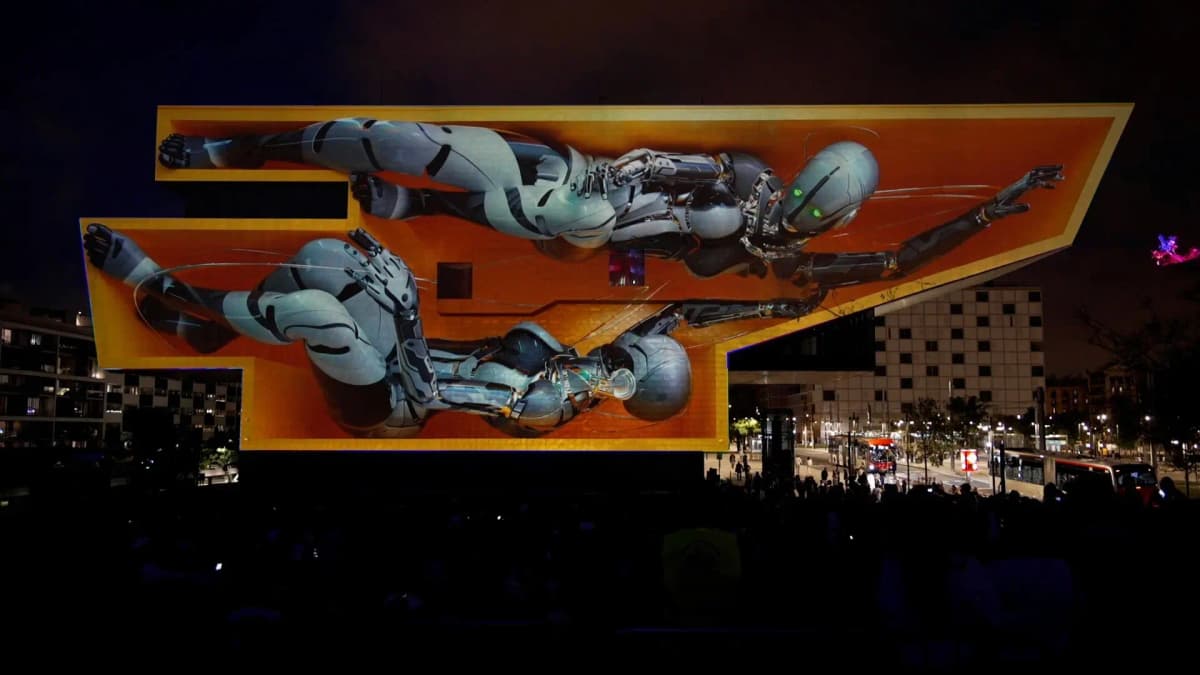
Frameboy has a direct connection to OFFF itself, having collaborated on The Screen in 2025, pictured on the cover. The studio’s place in the lineup brings the making of a festival experience into the conversation: how work becomes something an audience shares in a physical space.
These are our reasons for being curious about the participants. Individual talk subjects and the full timetable are still to come.
The practical bit
OFFF Barcelona runs May 6–8, 2027, at Disseny Hub Barcelona. More names are expected in the coming weeks.
The community newsletter announces a limited November Full Pass offer of €250, compared with €330, with subscribers getting access one day before the public launch. The email doesn’t specify a closing date; check the official ticket page for current availability and terms.
For now, the first announcement gives us a promising mix of familiar voices, different studio cultures and people we’d like to know better. That’s a good start to a festival.