Sometime in late 2016, Ben Barry sat in a coffee shop in southeast Portland and drew a small flower in his sketchbook. He didn't know it yet, but he was setting a category convention. The radiating, six-fold, hand-drawn symbol — meant to suggest a blossom opening, not a logo template — would become the visual cliché for an entire industry within five years. By 2026, every other AI startup ships some variation of it: a centrifugal sigil with soft strokes that says we are precise but warm. The Blossom is now the dental tooth of AI.
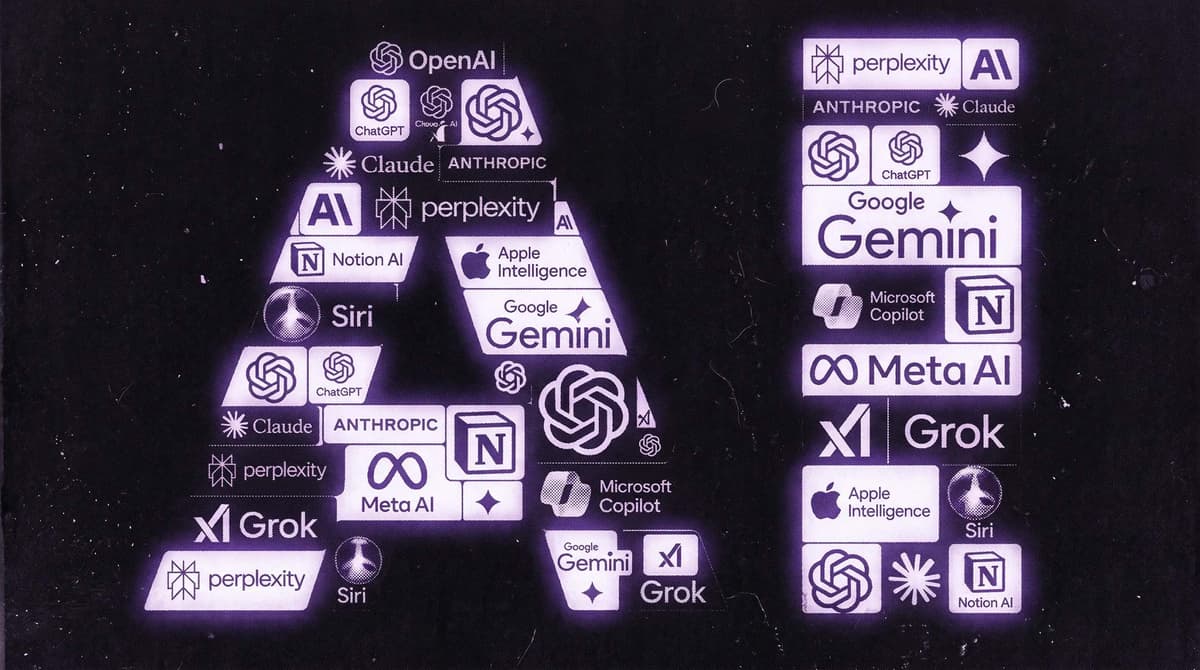
That convergence is only half the story. Spend an afternoon clicking between Perplexity, Claude, ChatGPT, Gemini, Copilot, Meta AI, Apple Intelligence, and Grok and a pattern emerges that has nothing to do with the underlying models. The brand identities of the AI era are splitting into two opposing camps — and the camp a product chooses tells you what kind of relationship it wants with its user.
On one side: calm, editorial, almost invisible. Perplexity, Anthropic, Apple Intelligence, Notion. On the other: magical, glowing, gradient-soaked. Meta AI, Google Gemini, Microsoft Copilot, the Siri glow. And then there's xAI's Grok — dark, irreverent, intentionally polarizing — sitting outside both groups on purpose.
The brand identity isn't decoration. It's a thesis about what AI is supposed to feel like.
Perplexity: invisible on purpose
The clearest articulation of the calm school comes from Smith & Diction's Perplexity case study, published August 18, 2023. They describe the goal in plain language: build an "invisible brand" — a neutral vessel for facts, with a wordmark that nods to citation and search rather than personality.
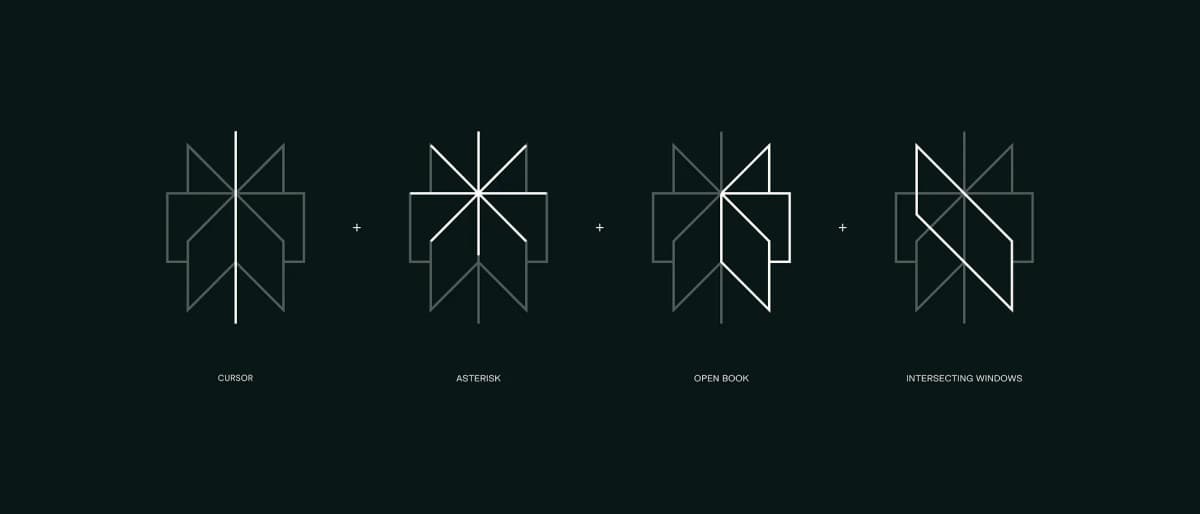
Most startups want loud differentiation. Perplexity argued the opposite: a research tool should get out of the way. The interface is a text field, the answer, and source cards. Inline citations are the whole product promise. The brand reinforces that restraint — quiet typography, no mascot, no gradient. If you can't quite remember what the logo looks like, that's the point.
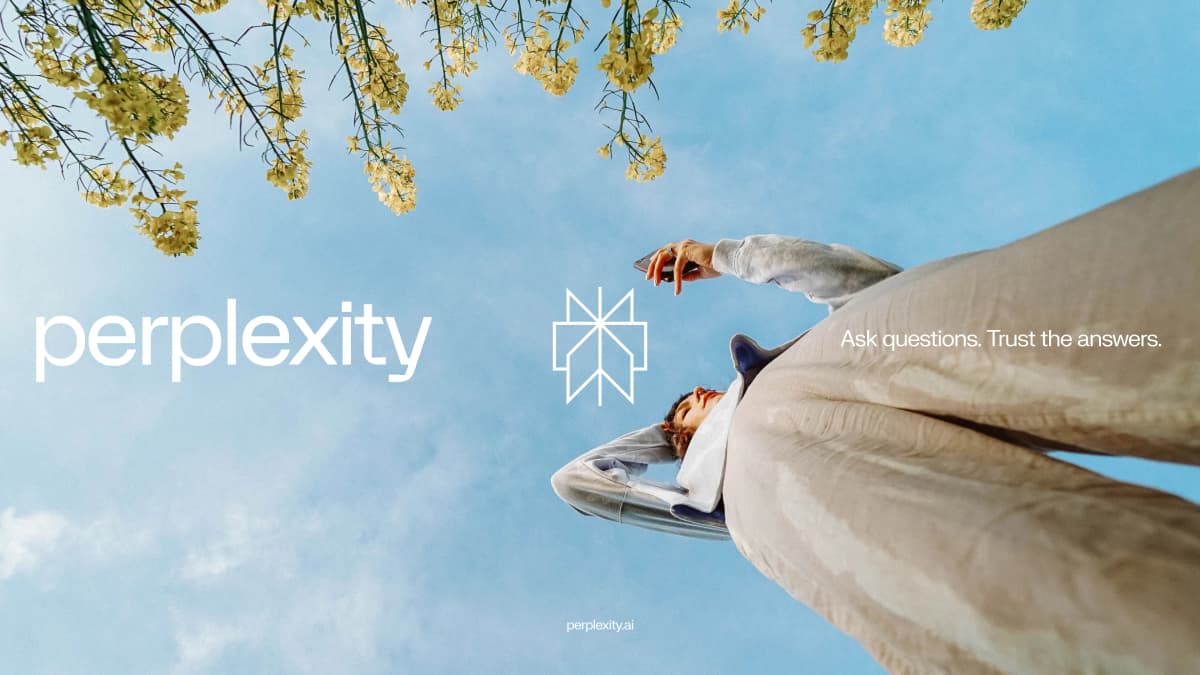
There's a deeper claim hiding in this. Perplexity is betting that citations make trust legible. Whether citations actually improve user accuracy — or just create the feeling of trustworthiness — is an open question that nobody has cleanly proven. But as a brand strategy, it's the strongest example of design and product thesis lining up.
Anthropic: warm, bookish, deliberately analog
Anthropic's identity, captured in ByEverett's portfolio, is unusually warm for an AI lab. Earth tones, serifs, an editorial layout that feels closer to a small press than to a frontier research company. Claude, by extension, reads as cautious and considered. It's a deliberate counter-position. While the rest of the category was reaching for chrome and gradients, Anthropic reached for paper.
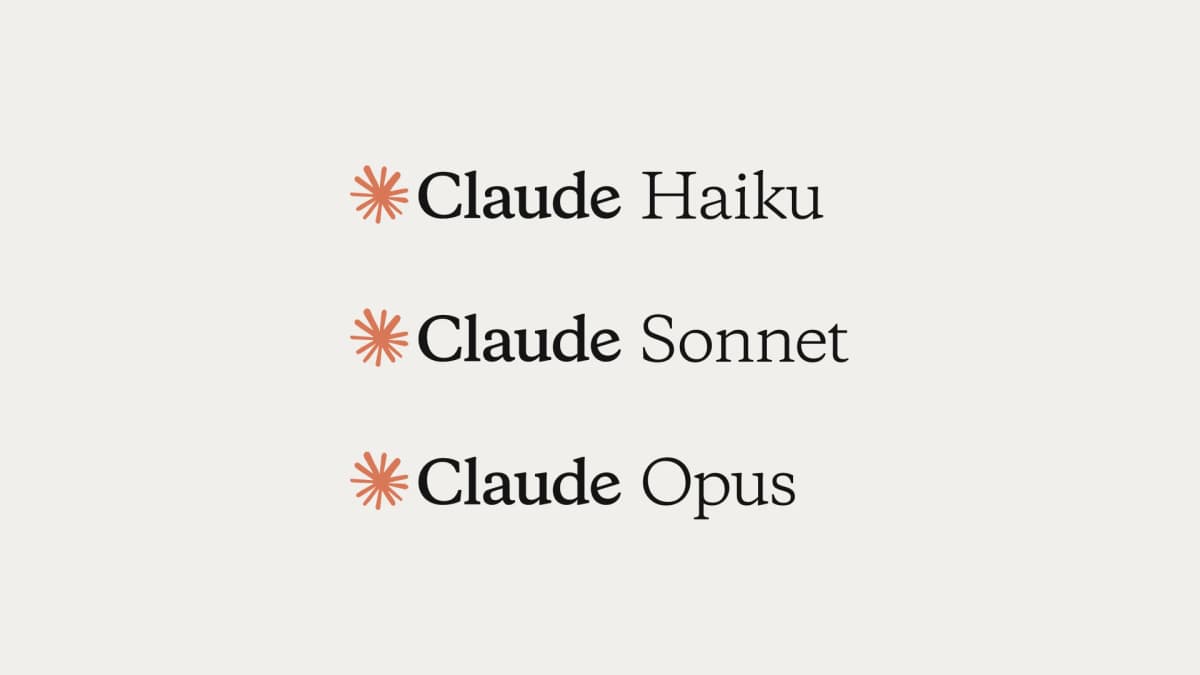
The result is the most un-AI-feeling AI brand on the market — and probably the most trusted in some quarters because of it. The bet pays off twice: once at the brand layer (you remember the warmth) and once at the product layer (Claude's voice matches the visual register).
Anthropic is also where the chatbox-to-canvas evolution got its sharpest expression. With Claude 3.5 Sonnet on June 20, 2024, the company introduced Artifacts — a side panel where Claude renders documents, code, or interactive components alongside the conversation. It reframed the assistant from a stream of replies into a workspace. ChatGPT followed with Canvas in October 2024; Microsoft pushed Copilot toward Pages and "dynamic windowing" in its May 2025 design post. The chatbox is no longer the product.
Ben Barry: the hand behind the Blossom
Most of the AI sparkles in 2026 trace back, more or less directly, to one designer's sketchbook. Ben Barry — Texas-trained, ex-Facebook (five years on internal branding and culture work), independent in Brooklyn from 2014 — got a call in late 2016 from Ludwig Pettersson, the ex-Stripe creative director who was OpenAI's first in-house designer.
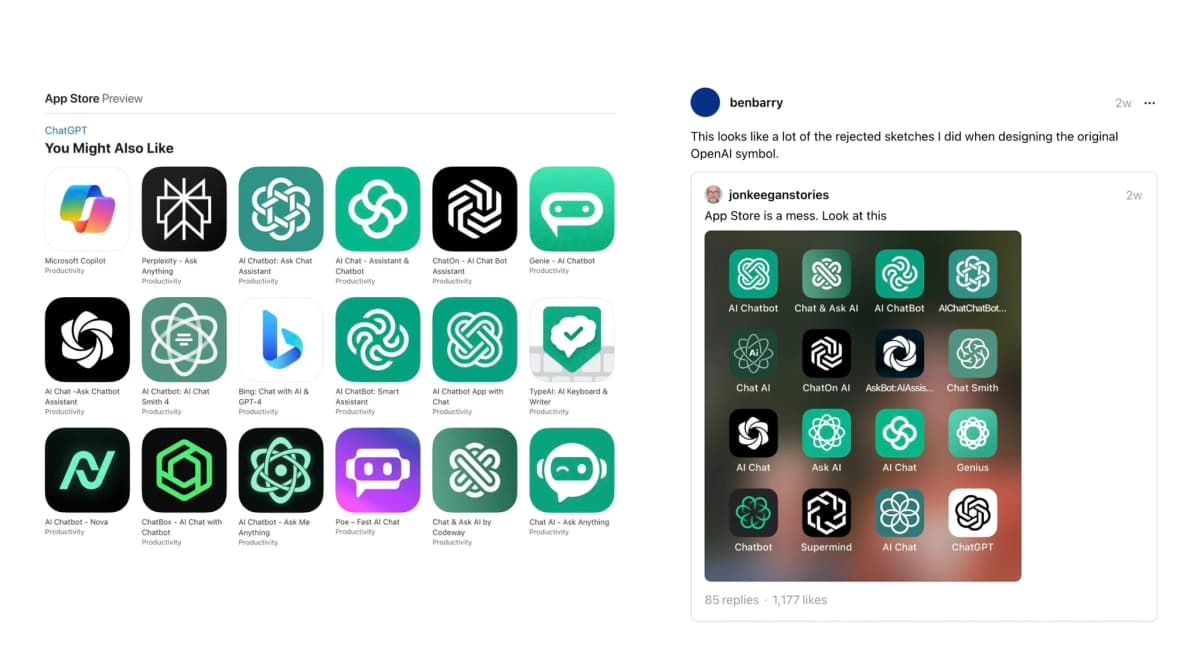
Barry drew the first version of the symbol one weekend morning at Hart Coffee in southeast Portland. The concept stacked three ideas: a hexagon at the center for the precise, geometric machine; lines radiating outward for the spark of emergence; and a blossoming exterior for the organic, aspirational result. He drew the symbol with varying stroke weights — partly to suggest depth, partly as a rejection of what he called the "artifact" of Illustrator and Figma. He wanted the logo for artificial intelligence to feel drawn by a hand. The wordmark, built on a Process Type Foundry face with a custom variant cut by Erik Olson, was tuned around a single requirement: an unambiguous capital I, because at the time people kept reading "OpenAI" as "open."
The irony writes itself. The symbol Barry made to feel hand-drawn became the most-imitated mono-line mark in tech. OpenAI didn't have products in 2017 — it had white papers — and the Blossom appeared on cover artwork that looked closer to a small academic press than to a Silicon Valley startup. By the time ChatGPT launched in November 2022, the symbol had spent six years being seen mostly by researchers. It then went mainstream within a quarter and became a category template inside another six months.
Barry left OpenAI in 2020, burned out, and returned to consulting. Since then he has done identity work for Cursor, Sierra (customer support agents), Compose Robotics, and Run (AI pen-testing). The same hand has touched both endpoints of how most people now experience AI: the symbol on the chat tab, and the cursor in the IDE. There's a half-joke worth taking seriously here — when you look at how much of the category Barry's pen has touched, the shortest path to a successful AI brand might just be commissioning the right designer.
OpenAI: from neutral to motion-first
ChatGPT's original launch in November 2022 shipped with a deliberately unfinished interface — a chatbox, a sidebar, examples, a model picker. That bareness was its own statement: no opinion, no aesthetic, no positioning. The product was the conversation. It was framed publicly as a low-key research preview, and the "low-key research preview" became the default visual register for AI assistants for nearly two years.
A 2025 OpenAI brand refresh — credited to Studio Dumbar, with reporting around a custom typeface called OpenAI Sans — pushed OpenAI toward something more deliberate: motion-first identity, more visual confidence, fewer apologies for being a brand. Whether that scales across a product used by hundreds of millions of weekly users is the open question. It's hard to look minimal when you've become category-defining.
Google Gemini and Microsoft Copilot: the magical glow
Gemini, announced in December 2023 and rolled out across Search, Workspace, and Android through 2024, leans hard on a sparkle mark and Google's full Material color palette. The most recent identity refresh is the work of Porto Rocha, who reframed Gemini around what they describe as the "human-centered expression of Google's innovation" — gradient stars, luminous motion, and tighter coupling with Google Sans. Copilot, in Microsoft Design's own words (Jon Friedman and Kurtis Beavers, July 2023), uses Fluent gradients and a glowing mark to signal an AI moment inside Word, Outlook, and Windows.
Both are betting that "magical" is the right register for AI inside enterprise software. The gradient says: something is happening here that wasn't possible before. A small visual flourish does the work of telling a Word user that the next paragraph wasn't typed by them.
But Microsoft's article is doing more than declaring a style — it's introducing a category they call "appropriate trust." Their team explicitly argues that AI labels, fallibility notices, prompt suggestions, and review moments aren't UX details, they're the substance of the interface. Copilot's gradient is the headline; the badges, the sidebars, and the "AI may be wrong" copy are the actual product. That's the stronger lesson buried inside the magical school: the gradient is just a wrapper for trust scaffolding.
The risk is also obvious. When every product uses the same shimmer to mean "AI," the shimmer stops meaning anything. By 2026, the four-pointed sparkle reads as category convention rather than identity. Any product still using it is borrowing equity, not building it.
Apple Intelligence: AI as system layer
Apple's June 10, 2024 announcement skipped the word "AI" almost entirely. The product is named Apple Intelligence — positioning it as a native capability of the OS, not as a chatbot you visit. There is no Apple Intelligence app. There is a Writing Tools menu, Priority Messages, summaries inside Notes, and Siri.
The visual signature is the Siri glow that wraps the screen edge during invocation. It's the only piece of overt AI-ness in the system, and it's spatial rather than logo-based. The other half of Apple's brand argument is the Private Cloud Compute graphics — diagrams and copy explaining what runs on-device, what gets sent to a server, and what Apple cannot see. Privacy carries as much brand weight as anything visual. The thesis: AI is a system feature, branded like a system feature.
Meta AI: ambient gradient
Meta AI, launched broadly with Llama 3 on April 18, 2024, uses a blue-purple gradient orb as its mark, deployed inside WhatsApp, Instagram, Messenger, and Facebook search. It's the cleanest example of the magical school — a glowing object that means AI is here without explaining what AI is.
Meta's design problem isn't really visual. It's service design: how does a single brand mark behave consistently across five different apps with five different cultures? The gradient orb is a portable signal more than an identity. The same object has to feel native inside an Instagram DM, a WhatsApp group chat, and a Facebook search bar — surfaces with very different tones and visual systems.
xAI Grok: irreverence as positioning
Grok, rolled out to X users from late 2023, is the outlier. Dark palette, blunt typography, a tone that's deliberately abrasive. Where everyone else is competing on warmth, capability, or trust, Grok competes on attitude. The brand promises an AI that won't lecture you.
It's a real positioning bet. Personality as differentiator works — until it bumps into the safety, accuracy, and trust problems every AI product has to solve. A brand that tells you it's irreverent has a harder time telling you it's reliable. Grok is the cleanest test of how far tone alone can carry a product.
The split isn't aesthetic. It's a bet on whether AI should feel like a tool you use or a presence you collaborate with.
Notion AI: personality with a face
A useful counterexample to both schools: Notion AI, animated by BUCK with a small handmade character. Ryo Lu, in Notion's own design post from September 21, 2023, explained the deeper choice — Notion AI does not exist as a separate destination. It appears when you press space on a blank line, or select text and ask for a rewrite. The interface stays out of the way until the user invokes it.
The character animation is the brand surface; the contextual invocation is the product. Together they argue for a third way: not invisible (Perplexity), not glowing (Gemini), but charming — a tiny face that softens a powerful model without pretending to be a person. It's anthropomorphism with a leash on it.
Cursor: identity as typography
Cursor began as a thin wrapper — a fork of VS Code that piped whatever model the user wanted (Claude, GPT, Gemini) into a familiar IDE. It shouldn't have worked as a brand. With no proprietary model until Cursor 2.0 shipped Composer in October 2025, the company was, on paper, dependent on its competitors' technology. Instead, through 2024 and 2025, it became the dominant interface for developer-AI work, and the brand did real load. The arrow mark — an elegant pointer that doubles as a text caret — is one half of the identity. The recent refresh, by Kimera (the type foundry behind Waldenburg), is the other half.
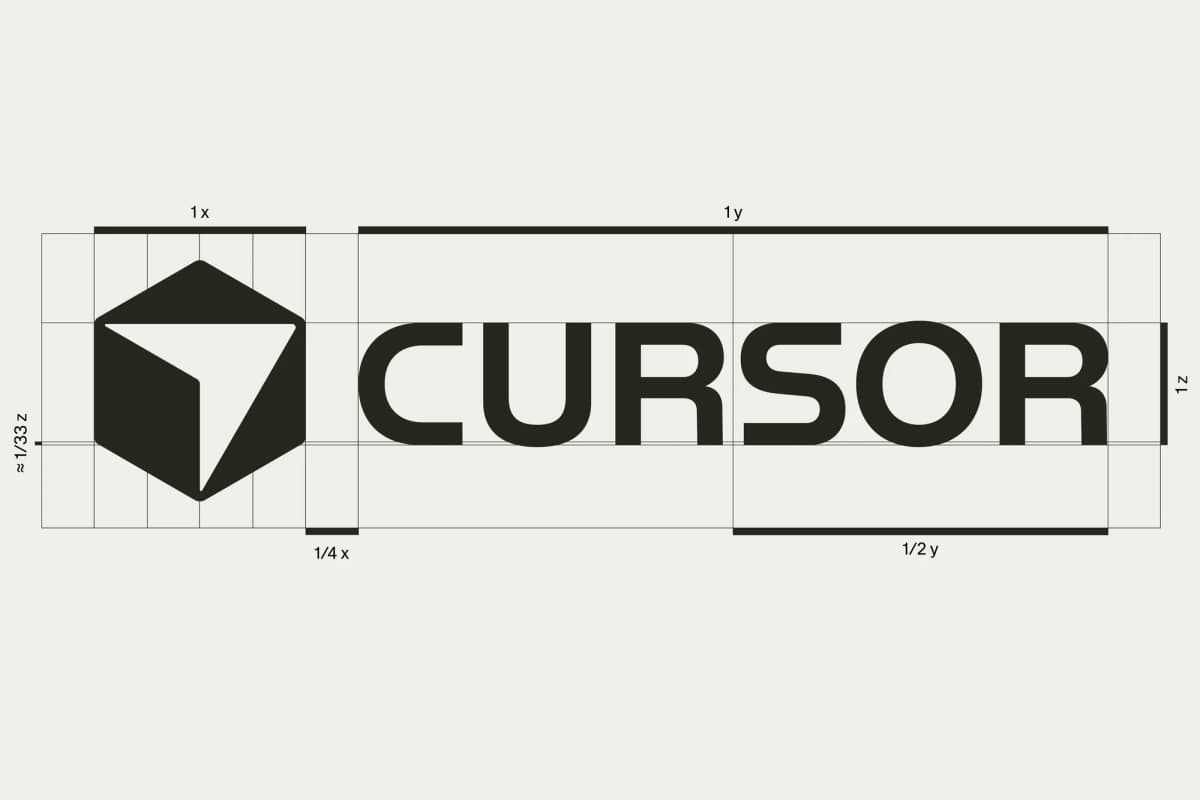
Kimera adapted Waldenburg into a sharper Cursor Gothic and cut a monospace variant for the IDE itself, so the typeface running inside the editor and the typeface on the marketing site are the same family. They also ship the arrow in two registers — a flat 2D version and a 2.5D version with shaded facets that hint at depth — a small skeuomorphic gesture in a category that has otherwise abandoned skeuomorphism. In the licensed display weights, typing "logo" produces the mark via ligature. The brand and the editor share a font.
The argument is quieter than a gradient or a sparkle: we are a tool, and tools are made of type and surfaces, not auras. For a product that lives inside other products, that's the right register. It's also a useful counter-data-point to the rest of this piece. Most of the brands here lean on a logo or a glow. Cursor leans on type. The thing the user looks at all day is the same thing the brand is built out of.
Hardware: when industrial design can't save interaction design
The starkest test of AI brand and interaction design happened in physical objects. Two products launched within months of each other — Humane's AI Pin (announced November 9, 2023) and the Rabbit R1 (announced at CES January 9, 2024) — both promised a "post-smartphone" moment, and both became the year's loudest cautionary tales.
Rabbit's R1, designed in collaboration with Teenage Engineering, was the more visually ambitious of the two: bright orange, tactile, with a scroll wheel and rotating camera. iFixit's May 2024 teardown delivered the line that defined the category's problem: the R1 felt like "an Android app placed inside custom hardware." The industrial design was real; the interaction model was thin.
Humane's AI Pin was the inverse — minimalist, screenless, industrial — and arguably suffered worse. Imran Chaudhri and Bethany Bongiorno, both ex-Apple, built a wearable that asked users to trust voice and laser projection in place of a screen. By February 2025, reporting confirmed HP had acquired Humane's assets and the Pin's services were winding down. The lesson is not that hardware can't host AI. It's that "post-phone" AI needs visual confirmation, privacy signaling, and reliable feedback loops. A beautiful object can't compensate for an opaque interaction.
What this means for designers
A few patterns worth taking from the field:
1. The "AI sparkle" is becoming generic. Four-pointed stars and gradient orbs were distinctive in 2023. By 2026, they read as category convention. Any product using them is borrowing equity, not building it. The Figma Weather episode is the same problem one layer down — when AI generates UI, it tends to converge on the most-trained example.
2. Naming is positioning. "ChatGPT" is a destination. "Apple Intelligence" is a system layer. "Claude" is a colleague. "Copilot" is an assistant. "Grok" is an attitude. The name does most of the work before any visual identity gets a chance.
3. Trust is a brand surface, not just a UX detail. Perplexity's citations, Microsoft's "appropriate trust" framing, Apple's Private Cloud Compute graphics — these are the real brand statements. They tell you what the product believes about itself. The gradient is paint on top.
4. The chatbox isn't the product anymore. Artifacts, Canvas, Copilot Pages, Notion's inline rewrite — the strongest interaction work in 2024–2025 has been about getting AI out of the message stream and into editable objects and embedded surfaces. Brand work that still treats "AI" as a destination is one cycle behind the product.
5. Restraint is starting to win. As the magical school crowds the visual middle, the invisible school inherits the ability to feel different. Anthropic and Perplexity stand out precisely because they refuse the gradients. The least memorable brand in a sea of sparkles is the most memorable.
The interesting brand work in AI over the next two years won't be more sparkles. It'll be teams figuring out what their product feels like when it works perfectly — and designing for that feeling, not for the category convention.
For a closer look at the smaller AI brands taking that bet — Suki, Robin, Cohere, Faculty, Pienso, Parloa, Heidi, Sierra, LangChain, Rogo, Diffblue, Cresta — see the follow-up: Twelve AI Brands Designing Around the Category Cliché.